India has the second-largest digital shopping base in the world with approximately 290-300 million online shoppers, so it’s no wonder that so many sellers are continually on the hunt for new opportunities to get their products seen.
As more sellers fight for the attention of online shoppers, it’s becoming harder than ever to stand out on marketplaces brimming with options. Marketplaces have long been a go-to option thanks to their convenience, so more and more Indian brands are making the switch to D2C business models.
What Is a D2C Business?
Many sellers in India rely on well-known online marketplace platforms since they have an existing audience and manage the entire process, covering everything from sending out orders to handling customer inquiries. Although this has its benefits, it makes it hard for a seller to grow their own brand name.
Standing for direct-to-consumer, D2C is a sales strategy that cuts out the need for a middleman. This means the seller manages transactions themselves rather than selling their products through a third-party retailer.
Switching to a D2C business allows a brand to manage the entire customer journey itself without having to pay a commission for every sale made. Whether they choose to sell their products through their own website or an app, being able to oversee the entire sales funnel gives them more control over how they portray their brand.
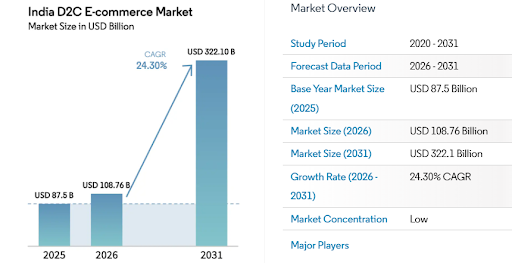
As we can see from the graph below, the D2C market is becoming increasingly popular, and this growth is expected to grow from approximately $108.76 billion in 2026 to $322.1 billion by 2031, representing a 24.3% CAGR. As more and more brands look to launch their D2C business, it’s only going to get more competitive, so now is a better time than ever to make the transition.
How to Run a D2C Business in India
When a seller is used to operating on third-party sites, launching a D2C business can seem like an intimidating prospect, but that doesn’t have to be the case.
Nowadays, there are various tools available that mean creating a new eCommerce platform can be done much quicker and cheaper than it would have been previously.
Let’s break the process down into smaller steps.
Identify a niche
Existing marketplaces already have an established audience, but a direct-selling brand must attract shoppers itself. Targeting a clearly defined niche is more likely to generate results. The key is to identify a genuine gap in the market.
Narrowing down the target audience and researching its pain points, buying behaviour, and preferred platforms can guide the launch in the right direction.
Pick an ecommerce management platform
When launching a new D2C business for the first time, using an eCommerce management platform makes the process much simpler since everything can be managed in one place.
The platform will streamline everything from listing a product with AI to recording it all in one dashboard, so it is easy to keep an eye on.
There are various eCommerce management platforms to choose from, so it’s important that sellers pick an option that caters to their target market and online store size, offering bigger plans that the seller can switch to as the business grows.
Establish branding
One of the biggest opportunities when creating a D2C business is having the opportunity to create a recognizable brand image.
Making the leap from being just another seller in a marketplace to having a clear identity as a brand helps a lot of sellers take their business to the next level.
Creating a set of brand guidelines that defines the values of the brand, the color palette that will be used, the tone of voice of the brand, and the layout of each page helps ensure that consistency is maintained across the platform.
Define the delivery and returns process
Setting up a delivery policy is new territory for sellers who are used to working with marketplaces that manage that for them, so it needs to be well thought out before the D2C business is launched to the public.
For businesses operating in India, picking a local logistics company is likely to be the most effective route, but for sellers looking to work on a global scale, a deeper understanding of the options available is needed.
It’s also important to create a detailed returns policy that informs shoppers of the process before they place an order.
Set up customer support and retention
Running a D2C store means the brand is responsible for every customer interaction, including product questions, order updates, cancellations, returns, refunds, and post-purchase support. Before launching, sellers should decide which channels customers can use to contact them, such as email, live chat, Instagram, or WhatsApp.
As order volumes grow, managing these conversations separately can lead to slower responses and missed messages. An omnichannel support platform can bring conversations and Shopify order information into one inbox, helping support teams respond with the right context. Brands can also explore how automation reduces repetitive customer-support work in online stores.
D2C brands should prepare automated communication for common customer journeys, including:
Used thoughtfully, WhatsApp can support these journeys while keeping the conversation accessible to customers. This guide to AI WhatsApp customer support for ecommerce retention explains how automation and human assistance can work together.
Brands should monitor response time, resolution time, customer satisfaction, repeat-purchase rate, and return reasons. These insights can help improve both the customer experience and long-term retention.
Plan a marketing strategy
When building up a new audience, marketing is key. Being able to directly reach the target market and engage them with a relevant product offering requires a carefully crafted marketing strategy.
The seller needs to consider which channels are likely to be the most effective, whether that be organic options such as social media and search engine optimization, or paid marketing channels such as paid ads.
The trick is to create a content calendar that defines what campaigns are going to go live at what time, maintaining a steady stream of content.
Try different products
Once the D2C business has been launched, the seller will build up a dataset that offers much deeper insights than they got through selling on marketplaces.
Continuously analyzing this data will give invaluable insights into the success of each product. This will allow the seller to see what customers are really looking for and adapt their product offering accordingly.
Selling from a direct eCommerce platform gives the seller much more creative freedom over this since they can play around with different ideas and see what works.
The Benefits of D2C Over Marketplaces
Marketplaces are always a good opportunity for new sellers who are looking to start up their new business, but there are limitations to contend with. This is why many sellers looking to grow switch to a D2C business.
Here are some of the main benefits of switching to direct selling:
- No commission. A D2C business gives the business owner full control over their finances as the brand may avoid marketplace commissions. However it still pays for payment processing, logistics, returns, technology, advertising, and customer acquisition.
- Less direct competition. Although marketplaces give sellers access to an existing audience, there tend to be a lot of other sellers offering very similar products. Being listed right next to a direct competitor limits sales opportunities. This is why having a dedicated eCommerce platform helps businesses build up their own customer base.
- Fewer restrictions. Selling on a third-party platform means following the rules they have around product types, pricing structures, and promotions. The flexibility of being able to play around with different strategies in a D2C business offers more opportunities to sellers.
- More growth opportunities. There is only so far a business can go when selling on marketplaces, so for sellers looking to take the next step, launching their own brand allows them to create a memorable brand image and online shopping experience.
Why More Indian Sellers Are Launching D2C Businesses
The eCommerce industry has long been growing, but now that launching a new D2C platform is becoming more accessible to sellers with no prior development experience, the industry is booming.
Since a custom eCommerce platform can be created without the help of a dev team, it has opened up new opportunities that were once only available to larger businesses with a significant budget.
Although the accessibility of launching a D2C business is a great opportunity, it’s also expected to bring more competition as other sellers join the bandwagon. This is why now is a prime opportunity to get ahead of the crowd.