Competitor analysis is not one task. An SEO competitor analysis tool is really being asked to do four discrete data jobs: discovering your true organic rivals, extracting the keyword and content gap, mapping the link gap, and benchmarking visibility inside AI answers. Most comparisons score a feature checklist without checking whether the job runs at the scale of a large site. The fourth job is the volatile one: run the same query through Google's AI Mode three times and the exact cited URLs overlap only ~9.2% between runs (SE Ranking's AI Mode study), so AI-answer visibility has to be tracked continuously, not sampled once. The table compares each tool against the four jobs; the sections after it define what each requires.
How we evaluated the tools: We compared publicly documented capabilities, current pricing, API availability, scalability, and the supplied product interfaces across the same four jobs. Pricing and feature availability were reviewed in August 2026 and may change.
The tools against the four jobs
| Rank | Tool | Real-competitor discovery | Keyword + content gap | Link gap | AI-answer benchmarking | API | Entry price |
|---|---|---|---|---|---|---|---|
| 1 | SE Ranking | Yes | Yes | Yes | 5 engines | Every plan | $129/mo |
| 2 | Ahrefs | Yes | Yes | Yes (Link Intersect) | Brand Radar | Included/metered | $129/mo |
| 3 | seoClarity | Yes | Yes | Yes | Add-on (ArcAI) | Yes | Custom |
| 4 | Semrush | Yes | Yes | Yes | Yes | Add-on | $139/mo |
| 5 | Serpstat | Yes | Yes | Yes | Team+ | Team+ | $50/mo* |
| 6 | SpyFu | Partial | Keyword only | Limited | No | Pro tier | $39/mo |
| 7 | Similarweb | Yes (traffic) | Keyword only | No | AI traffic | Yes | $125/mo† |
| 8 | Moz Pro | Yes | Keyword + link | Link Explorer | Yes | Metered | $49/mo |
*Serpstat entry on annual billing. †Similarweb self-service entry; higher tiers quote-based.
Job 1: Find your true organic competitors
The domains taking your clicks are rarely the brands your team would name in a meeting. They surface from SERP overlap - the sites ranking against you across your keyword set - not a manual list. A tool has to build that competitor set from ranking data and re-derive it as SERPs shift. The failure mode is quiet: benchmark against the wrong rivals and every downstream gap inherits the error.
Job 2: Extract the keyword and content gap at scale
A competitor keyword analysis tool has to return the terms your rivals rank for and you do not, split by intent and page. On large sites with 100,000 or more URLs, this needs batch or API access because a UI that caps rows can silently truncate the gap. For ecommerce teams, this analysis is most useful when it feeds a broader enterprise SEO strategy for DTC brands rather than becoming a standalone keyword export.
Job 3: Map the link gap and benchmark AI-answer visibility
A competitor backlink analysis tool maps referring domains linking to rivals but not to you - the intersection showing where authority is built without your name on it. The second half is presence: which domains get cited across AI Overviews and AI Mode. Edge case: those citations are volatile between runs, so a one-off snapshot misrepresents share of voice. Both halves need scheduled re-checks.
The full ranking: all 8 tools
1. SE Ranking
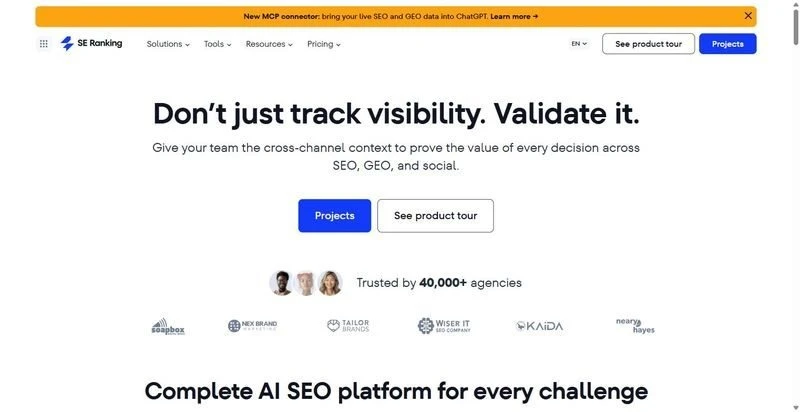
An SEO and AI-search visibility platform whose Competitor Research profiles any domain's organic traffic, paid keywords, top pages, and AI-answer presence.
Best for: Technical SEO teams that need discovery, keyword and content gap, link gap, and AI benchmarking in one platform with API access.
Standout: Among website competitor analysis tools, it spans Google plus five AI engines - AI Overviews, AI Mode, ChatGPT, Gemini, Perplexity - reporting mention and citation frequency, position in AI brand lists, and side-by-side benchmarking. API and MCP ship in every plan, so scripting gap pulls at scale needs no upgrade.
Pros:
Identifies real search rivals, then benchmarks keyword gap, backlink gap, and AI presence from one report.
Includes API and MCP on every plan - 25,000 monthly data credits on Core, 100,000 on Growth.
Cons:
Some domains and regions require a manual Expand Database request before data populates.
Competitor-domain count and historical depth scale with tier.
Pricing: Core $129/mo ($103.20 annual), Growth $279/mo; 14-day free trial.
Bottom line: It covers all four competitor jobs - discovery, gap analysis, link gap, AI benchmarking - without stitching separate tools together, and the bundled API suits teams scripting pulls. See how the Competitor Research module handles cross-engine benchmarking.
2. Ahrefs
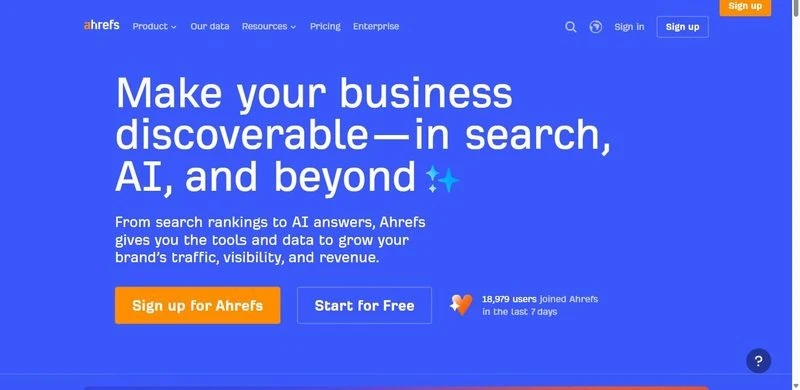
The largest independent backlink index, paired with competitor tooling across Site Explorer, Competitive Analysis, Organic Competitors, and Brand Radar.
Best for: Link-gap-led competitor work where backlink index depth is the deciding factor.
Standout: Site Explorer surfaces organic keywords, top pages, traffic estimates, and paid keywords; Competitive Analysis adds keyword, content, and backlink gaps via Link Intersect; Brand Radar tracks AI-search visibility.
Pros:
Maps backlink gaps with Link Intersect across multiple competitors at once.
Draws on the largest independent link index for referring-domain analysis.
Cons:
- Includes API access on paid plans, but usage is metered by plan limits, which can constrain large automated gap pulls.
Offers no true free trial.
Pricing: From $129/mo (Lite), Standard $249/mo; one seat per plan.
Bottom line: Pick it when the backlink index is the decision driver. API gating and per-seat limits are the friction point for large-scale automated pulls.
3. seoClarity
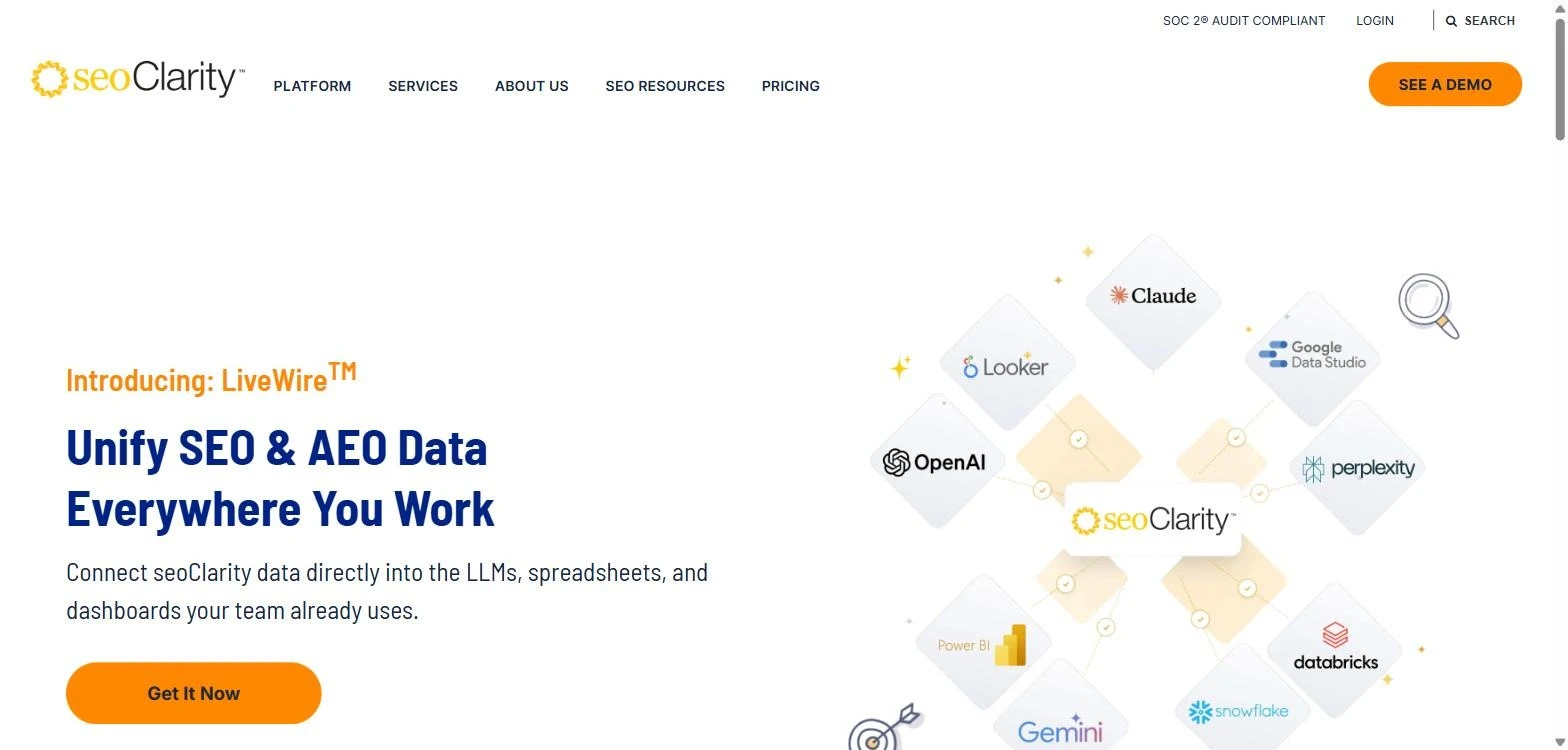
An enterprise SEO platform with unlimited keyword tracking, a large data warehouse, and the Sia AI assistant.
Best for: Enterprise teams tracking share-of-voice across very large keyword sets of 100k or more.
Standout: Competitor analysis runs at scale: rank tracking, share-of-voice, keyword and content gaps, SERP analysis, and backlink research. AI-search visibility comes through ClarityArcAI add-ons, not the base platform - scope that cost.
Pros:
Tracks unlimited keywords and share-of-voice across very large keyword sets.
Backs analysis with a large data warehouse and the Sia assistant.
Cons:
Publishes no transparent or entry pricing; expect quote-based enterprise contracts.
Requires steeper onboarding and account-management reliance, with several capabilities priced as add-ons.
Pricing: Custom quote-based enterprise only; published starting points run roughly $2,500–$4,500/mo, priced by domains and keywords tracked.
Bottom line: It fits enterprise teams tracking share-of-voice across 100k-plus keywords that can absorb quote-based pricing. Scope the AI add-on and onboarding overhead first.
4. Semrush
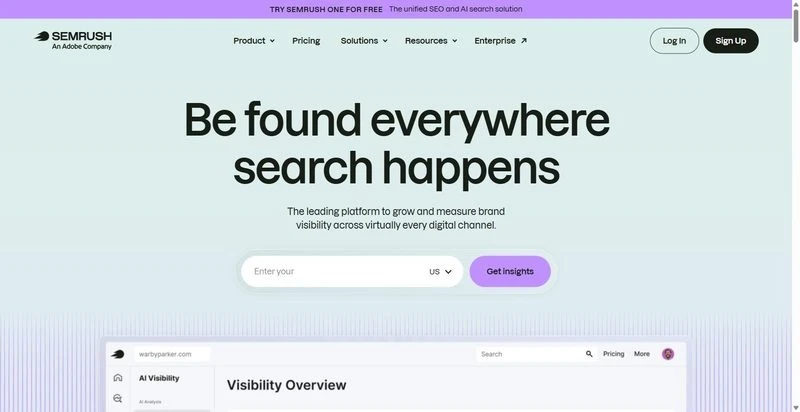
All-in-one suite spanning organic, paid, content, and AI search, backed by one of the largest keyword and competitor databases.
Best for: teams that want the widest keyword and ad database across organic and paid gap work.
Standout: Domain Overview and Organic Research map a rival's visibility; Keyword Gap and Backlink Gap surface missing terms; Advertising Research and PLA expose paid keywords and ad copy; Traffic Analytics and prompt tracking extend the view.
Pros:
Compare organic and paid gaps against rivals from one keyword database.
Track AI-search visibility and prompt-level mentions alongside classic SERP data.
Cons:
Traffic Analytics has historically sat behind a paid add-on.
Restricts each plan to one seat with daily report caps; API costs extra.
Pricing: From $139/mo ($117.33/mo billed annually); Starter tier $199/mo; free plan available.
Bottom line: For teams running organic and paid competitor work, Semrush covers the widest keyword and ad database in one place. Weigh the single seat, daily caps, and paid add-ons for Traffic Analytics and API.
5. Serpstat
All-in-one SEO platform covering organic and paid rankings, keyword and backlink gap analysis, plus AI Overview brand opportunity tracking.
Best for: mid-market in-house teams that need keyword and backlink gap plus API without an enterprise contract (on Team+).
Standout: Organic and paid keyword rankings feed keyword/domain gap views, domain-versus-domain comparison, and backlink gap analysis. The AI Overview Brand Opportunities report (Team+) flags where a brand can surface in generative results.
Pros:
Run keyword, domain, and backlink gap analysis against multiple competitors.
Access API, batch analysis, and MCP once on the Team tier.
Cons:
Restricts API, batch analysis, AI tools, and JS rendering to Team and above.
Holds smaller databases than the largest vendors.
Pricing: From $50/mo (Individual, billed annually); Team $100/mo adds API, batch analysis, AI tools, and MCP.
Bottom line: Serpstat fits in-house teams needing keyword and backlink gap plus API without an enterprise deal - but start on Team; the Individual plan omits too much, and databases trail the largest vendors.
6. SpyFu
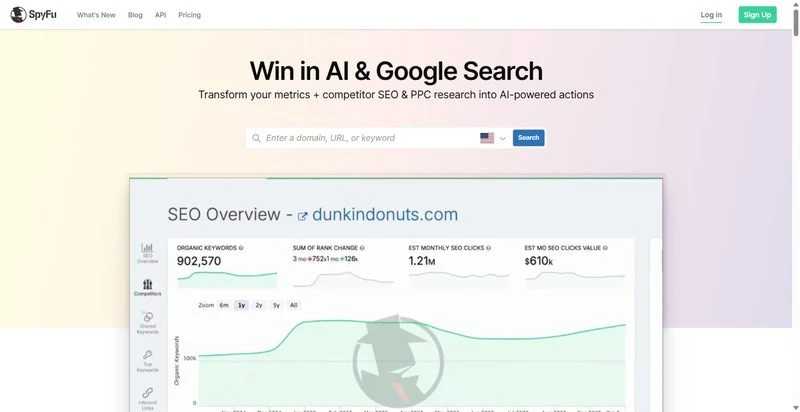
Competitive-research tool centered on rivals' paid and organic keywords, with multi-year ad history and ad-copy tracking over time.
Best for: reconstructing a rival's paid-search history and ad-copy timeline.
Standout: Pull a competitor's organic keywords and estimated traffic, AdWords keywords, and multi-year ad history showing how ad copy shifts. Kombat compares keyword gaps across up to three domains.
Pros:
Trace a rival's PPC keywords and ad-copy changes across years of history.
Compare keyword gaps across up to three domains with Kombat.
Cons:
Covers US data well but thins out internationally.
Holds a smaller backlink index and less accurate traffic estimates.
Pricing: From $39/mo (Basic monthly; $33/mo annual); Professional $79/mo adds API, unlimited exports, and 10+ years of history.
Bottom line: SpyFu earns its place reconstructing a rival's paid-search history and ad-copy timeline, where its depth is hard to match. Expect weaker international coverage; pair it with a dedicated link tool.
7. Similarweb
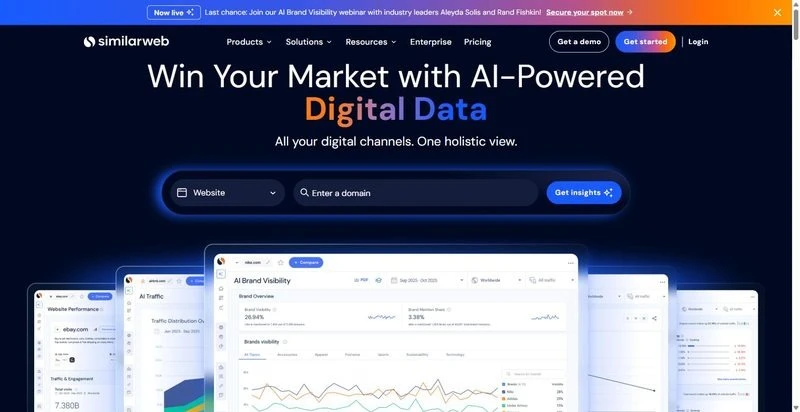
Market and competitive-intelligence platform that models a rival's full traffic picture from panel and clickstream data, not search alone.
Best for: Estimating a rival's total-market traffic and channel mix beyond search.
Standout: Traffic estimation spans total visits, source breakdown, audience overlap, and market share, plus ads intel and a Gen-AI suite tracking AI traffic. It answers where a rival's demand originates across channels, which search-only tools can't.
Pros:
Map a competitor's channel mix and audience overlap in one view.
Track ads intel and AI-traffic signals alongside organic estimates.
Cons:
Modeled panel data loses accuracy on smaller domains.
Backlink and on-page depth stay thin versus dedicated SEO tools.
Pricing: Self-service Web Intelligence from $125/mo (annual); Business and Enterprise quote-based.
Bottom line: Use it when the question is a rival's total-market traffic and channel split, not their backlink graph. Accuracy holds on high-traffic domains and degrades on small ones; pricing climbs with each suite.
8. Moz Pro
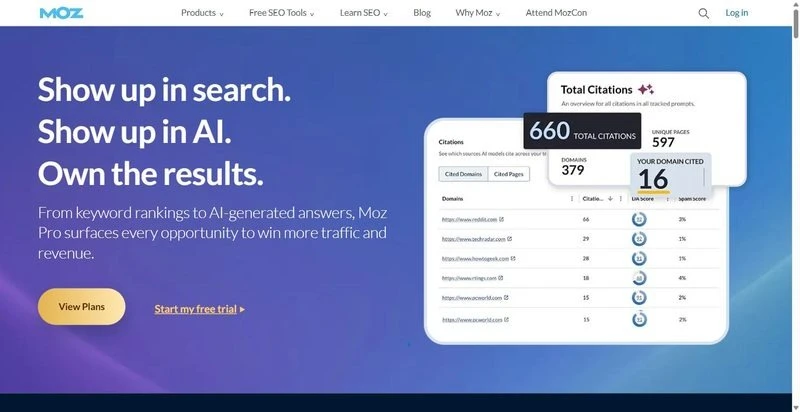
SEO platform organized around Domain Authority and Page Authority, now extended with AI-search tools for tracking citations across generative engines.
Best for: Teams that benchmark on Domain Authority and want AI-citation tracking beside it.
Standout: Competitive Research and Domain Overview drive keyword-gap analysis; Link Explorer handles backlink and link-gap work. AI Visibility dashboards add tracked prompts and citations across GPT, Gemini, and Google AI Mode.
Pros:
Benchmark competitors on DA/PA with link-gap analysis in one flow.
Track AI citations and prompts across GPT, Gemini, and Google AI Mode.
Cons:
Keyword and backlink databases run smaller than the largest vendors.
DA/PA are Moz estimates, not Google metrics, and queries are metered monthly.
Pricing: Starter $49/mo, Standard $99/mo ($79/mo annual), Medium $179/mo.
Bottom line: Pick it when your reporting is already anchored to Domain Authority and you want AI-citation tracking in the same tool. Accept smaller databases and metered queries; treat DA/PA as relative signals, not Google's own.
Matching the tool to the audit
Match the tool to the dominant job. If you need organic, keyword-gap, backlink, and AI-visibility audits plus an API in one platform, SE Ranking is the pick - API and MCP on every plan, five-engine AI benchmarking. If the audit is link-gap-led, the deepest backlink index wins (Ahrefs). For enterprise share-of-voice across 100k+ keywords, seoClarity scales further. For a paid-search teardown, SpyFu is the sharper instrument. Most shortlists of the best tools for competitor analysis conflate these jobs; separate them first, then match.
Competitor data creates more value when it informs the complete acquisition plan. Use the findings alongside these marketing strategies for 2026 to connect organic visibility with content, retention, and customer communication.
Skip if: Skip traffic-estimation-only tools like Similarweb when the job is a keyword or backlink gap; skip entry tiers that gate the API when you need to script gap pulls at scale.
FAQ
Can you run competitor analysis through an API instead of the dashboard?
Yes. Several platforms expose a Data API - SE Ranking includes API plus MCP access on every plan, while others gate the API behind higher tiers or metered credits. Through it you can script competitor pulls, keyword-gap queries, and backlink exports at scale, instead of clicking through the dashboard per domain.
What data does an SEO competitor analysis tool actually pull?
It pulls a rival's organic keywords and rankings, estimated traffic, paid keywords and ad copy, backlinks and referring domains, and top pages by traffic. Newer tools add AI-answer citations - which engines quote the domain across GPT, Gemini, and Google AI Mode - beside the classic search metrics.
How volatile is competitor visibility in Google's AI Mode?
High. Repeat runs of the same query in Google's AI Mode overlap only around 9.2% on the exact URLs cited, so a single snapshot misrepresents a competitor's real presence. Track continuously and read visibility as a distribution across runs, not as one fixed position.