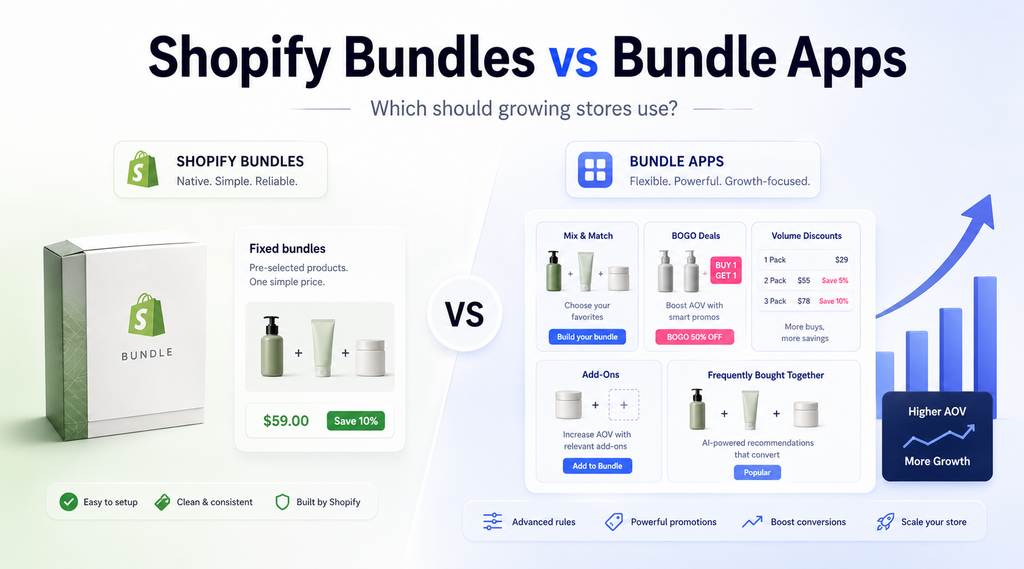
If you’ve ever tried to bundle products on Shopify, you’ve probably faced the same question many growing merchants face: Should you use Shopify’s free native Bundles app or install a third-party bundle app?
Shopify Bundles works well for fixed bundles and multipacks, but growing stores often need more flexible offers like build-your-own bundles, volume discounts, BOGO campaigns, add-ons, and frequently bought together recommendations.
This guide makes the decision easier. If you are comparing Shopify Bundles vs bundle apps, the right choice depends on your catalog size, bundle type, discount needs, and growth stage. We'll compare what Shopify Bundles can and can't do, go through when a dedicated bundle app actually pays off, and give you a simple framework to build a product bundling strategy that fits your store right now.
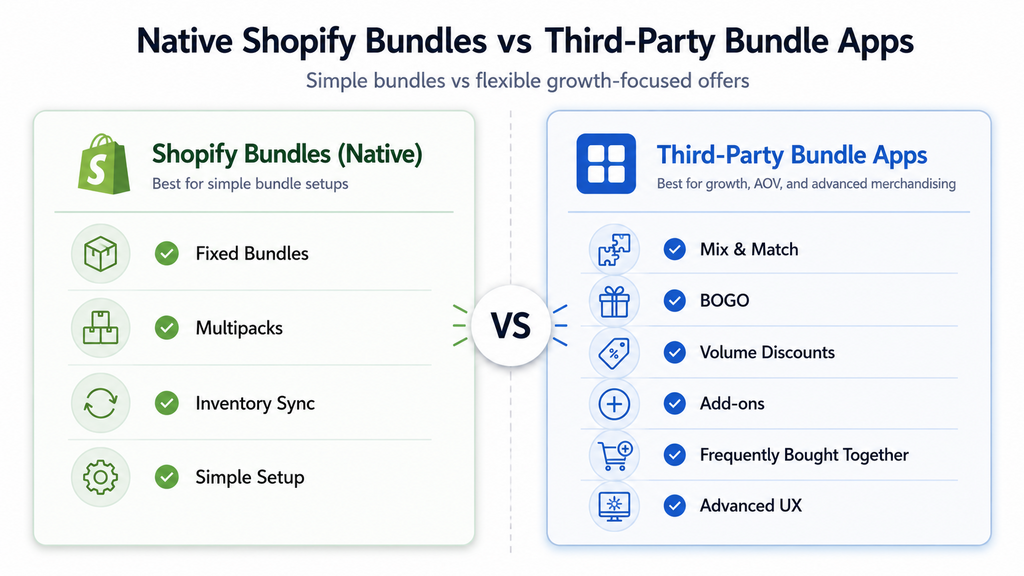
Before diving deeper, here’s a quick overview of how Shopify Bundles compares to third-party bundle apps for growing Shopify stores.
What Are Shopify Native Bundles?
“Shopify Bundles” is a free app built by Shopify itself. You install it from the Shopify App Store like any other app, and it’s instantly added to your store.
It handles two bundle types:
- Fixed bundles: a pre-defined group of products sold together (like a skincare kit with a cleanser, toner, and moisturizer)
- Multipacks: multiple units of the same product (a 3-pack of t-shirts)
Inventory accuracy is the main winning point for this app. When a customer buys a fixed bundle, Shopify automatically decrements each component product's inventory. You won't sync third parties into your admin, meaning there’s no risk of overselling when two systems disagree about stock levels.
Shopify Plus teams with developer resources can extend discount or checkout logic with Shopify Functions, but this is usually a technical implementation rather than a simple native bundle setting.
Note that it’s free and sets up in under ten minutes. These are enough for a lot of stores.
Shopify Bundles Limitations Compared to Bundle Apps
Here's where most growing stores eventually get into trouble. Shopify's native bundles cover the basics well, but not so much when it comes to extensive bundling.
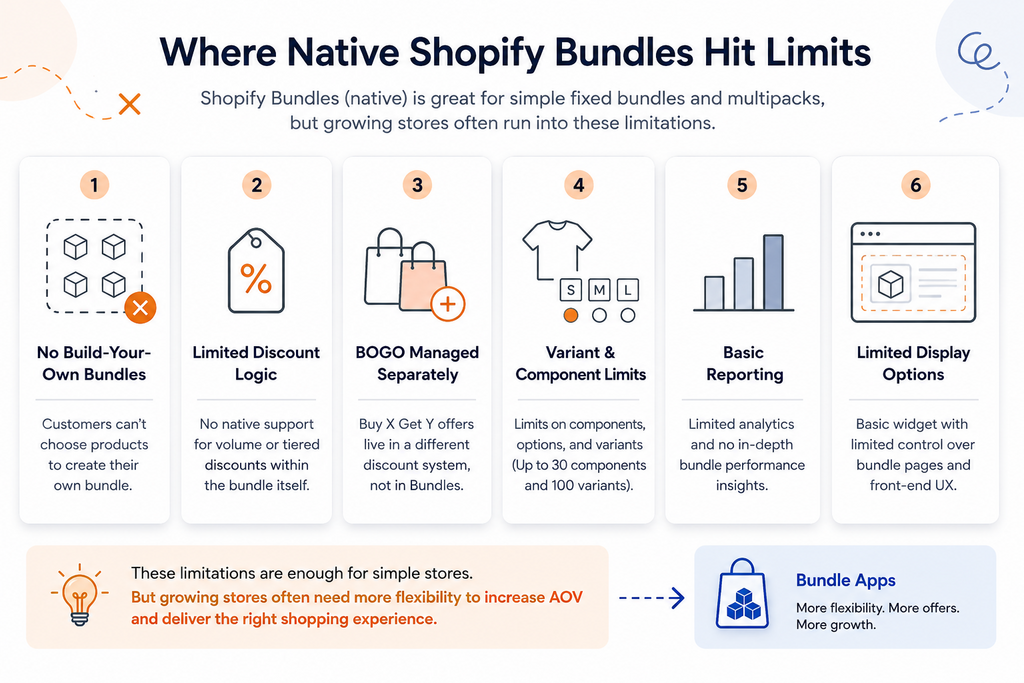
1. No build-your-own bundles: Customized bundles are where you can stand out, and in this case, native bundles fall short. Customers can't pick from a menu of options to assemble their own bundle. If you sell vitamins and want shoppers to choose 4 items from a list of 12, native bundles can't do that. You'd need to pre-create every possible combination as a separate fixed bundle, and most users just leave at this point.
2. No volume or tiered discounts: The classic quantity break isn't a native bundle. It has to be set up as a separate automatic discount. It doesn't display the same way and doesn't carry the bundle UX through to checkout.
3. BOGO lives in a different system: Shopify has the "Buy X Get Y" discount feature, but it's not part of the Bundles app. The two work in parallel, so you can't actually run BOGO in a single flow.
4. A variant ceiling: Shopify Bundles has limits around components, options, and variants. Fixed bundles can include up to 30 components, while bundles are limited to 3 options and 100 variants in total.
5. Reporting is minimal: Basic sales data is provided, but there are no dedicated bundle analytics. To take a look at conversion rate by bundle, AOV, best combos, etc, you’ll have to dig through reports manually or outsource.
6. Display options are basic: The native widget shows up the way Shopify decides it should. If you want a custom bundle page or a sticky banner for your offers, you’ll hit a dead end here.
When Native Bundles Are Enough
Getting a bundle app will cost you, so before committing, here’s a quick look at when and where the native option will be just enough for you. If three or more of these describe your store, start with native.
- Small catalog stores: under 50 SKUs, where pre-defining some fixed bundles covers your needs
- Simple bundle types: gift sets, starter kits, multipacks, holiday boxes
- Stores still testing bundling: You want to test whether bundling is worth it before paying for advanced features
- Tight budgets: the difference between $0 and $25/month matters for you
- Operation mentality: you care more about clean inventory and simplicity than UX optimization
When Shopify Bundle Apps Become Necessary
If your store has moved beyond simple fixed bundles, these are the signs that a dedicated bundle app may be worth the investment.
Your bundle catalog is exploding: You started with fewer bundles. Now you're trying to manage much more to cover customer needs, and you’re running out of time and energy. An app means a single setup and infinite uses.
AOV is your KPI: If you're actively running experiments to lift AOV or testing pricing tiers and pricing options, you need analytics that native bundles don't give you. A dedicated app with A/B testing and bundle performance dashboards will fit your business better.
Your catalog has heavy variants: Apparel with sizes and colors, supplements with flavors, electronics with configurations. Once your products carry many options, native's 100-variant ceiling forces workarounds that exhaust you.
You're scaling on Shopify Plus: Some enterprise stores run multi-region storefronts or big B2B catalogs. These all need to integrate with functions, Markets, and custom checkout extensions. Many advanced bundle apps are built with these scaling needs in mind.
You want bundles that your customers can build: Customizable bundles convert because they give shoppers agency. Native bundles can't deliver that experience.
For Shopify Plus and high-growth stores, the decision is less about whether bundles work and more about whether the store needs scalable bundle logic, flexible merchandising, and a cleaner customer experience across larger catalogs.
What to Look for in a Bundle App
Once you've decided an app makes sense, the next question is which one. Here is where you should categorize apps based on the options they give your store. Here’s a quick list.
- Bundle type coverage: Does it handle fixed, mix-and-match, volume discounts, BOGO, and frequently bought together in one app, or do you need to install more apps?
- Inventory accuracy: bundle apps that don't sync inventory in real time will quietly oversell you. Check reviews specifically on this point.
- Page speed impact: bundle widgets that inject JavaScript can hurt your Core Web Vitals and conversion rates. Look for apps that use Shopify's native app blocks rather than embedded scripts.
- Analytics depth: You'll need at least sales attribution per bundle so you can see what's actually working. A/B testing and conversion analytics on top of that are bonuses worth paying for if increasing AOV is one of your main KPIs this year.
- Pricing model: Some apps charge a flat monthly fee. Others charge based on bundle order volume, which can get expensive at scale. Read the pricing page first.
- Shopify Plus compatibility: if you're on Plus or planning to migrate, verify the app supports Functions, Markets, and B2B catalogs.
- Support quality: bundle setup can get technical when your theme isn't standard. Apps with responsive support save your time and effort.
Popular Bundle Apps Worth Considering
Deciding what’s best depends on how simple or advanced your bundle strategy needs to be. Some stores only need fixed bundles and multipacks, while others need mix-and-match offers, volume discounts, BOGO campaigns, add-ons, or custom bundle logic. Here are three options worth shortlisting.
Shopify Bundles (native)
Shopify Bundles is the simplest starting point for merchants who want to create fixed bundles and multipacks directly from the Shopify admin. It is free, easy to set up, and useful for stores that want to test product bundling without adding a paid third-party app right away. Its biggest advantage is inventory accuracy: when a bundle sells, Shopify updates the inventory of the individual products inside that bundle in real time.
Best for: Simple fixed bundles, multipacks, and merchants testing bundling for the first time.
Fast Bundle
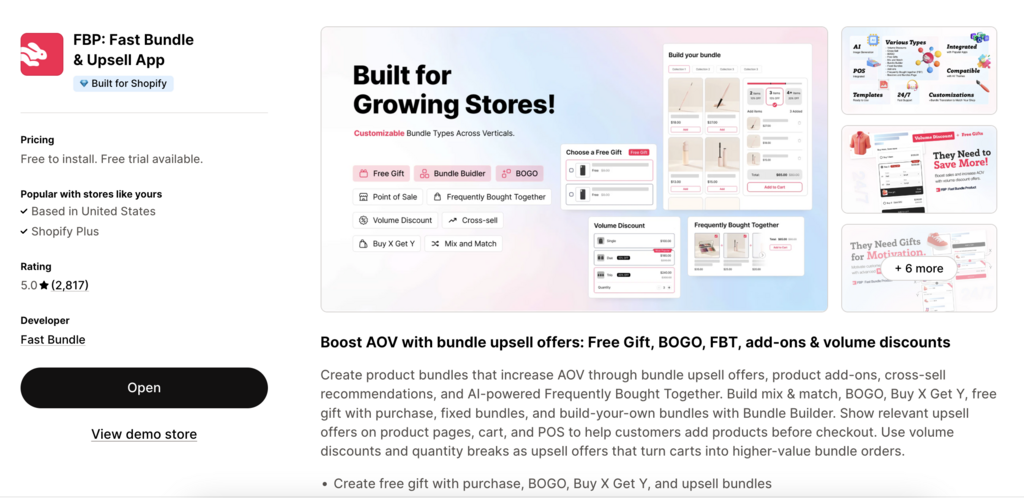
Fast Bundle is a strong choice for Shopify stores that want to turn product bundling into a real AOV growth strategy, not just a simple fixed-bundle setup. The app supports mix-and-match bundles, volume discounts, BOGO, Buy X Get Y, free gifts, product add-ons, and frequently bought together offers in one place. For growing brands and Shopify Plus merchants, it helps run more flexible bundle campaigns without relying on multiple separate apps.
Best for: Advanced bundle campaigns, AOV growth, mix-and-match offers, and flexible promotions.
Shopify Functions–powered custom apps
For Shopify Plus merchants with a development team, custom bundle logic can also be built using Shopify Functions and related Shopify APIs. This gives larger stores more control over pricing, checkout behavior, and backend logic, but it usually requires technical implementation and ongoing maintenance. It is best suited for enterprise merchants with very specific bundle rules that cannot be handled by a standard app.
Best for: Shopify Plus merchants with custom requirements, developer resources, and complex backend logic.
A Practical Decision Framework
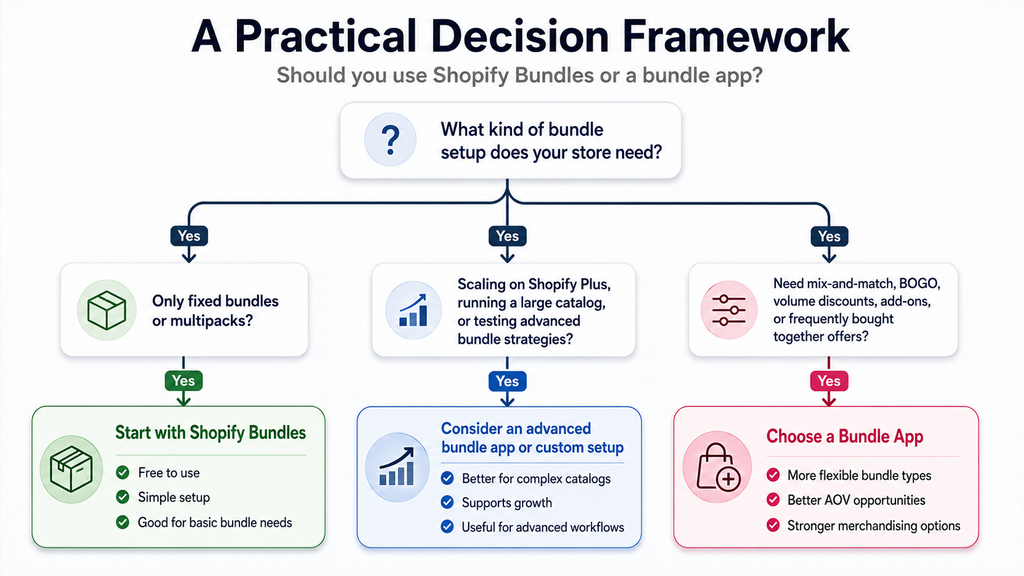
When merchants ask whether to start with native or jump to an app, this is the checklist that usually clarifies it:
- Do you want customers to build their own bundle?
- Do you need volume discounts or tiered pricing tied to the bundle itself?
- Does your catalog have more than 50 SKUs with multiple variants?
- Is increasing AOV one of your top three KPIs this year?
- Are you on Shopify Plus or planning to upgrade within 12 months?
Zero or one "yes" answers: Start with the native Shopify Bundles app. You're not yet at a point where paying for an app has proportional value.
Two or three "yes" answers: A bundle app is probably worth the cost. Focus on apps that cover your specific needs.
Four or five "yes" answers: You'll outgrow native quicker than you imagine. Invest in a bundle app with strong analytics, mix-and-match support, and Plus compatibility.
A Note on Migration
If you start with native bundles and later move to an app, the transition is usually easy, but plan for it. Most third-party apps can import existing bundles, and inventory continuity is preserved as long as your component products stay intact. The best idea is to run both for a week or two to get the hang of it.
Final Thoughts
To summarize, pick the one that fits your store today. You can always change later. Bundles aren't a magic AOV button. They work when the offer makes sense to the customer, and their experience is smooth. A good product bundling strategy starts with understanding which combinations your customers actually want, then picking the tools.
Stores with very simple bundling needs can start with native Shopify Bundles and test whether bundled offers work for their customers. But growing stores that care about AOV, mix-and-match offers, BOGO campaigns, add-ons, custom bundle pages, or stronger merchandising control will usually need a dedicated bundle app sooner.
The good news: Shopify's bundle ecosystem has matured enough that whichever path you take, you have solid options. The native app keeps getting better, and the third-party apps keep adding features that push the platform to evolve.
FAQ
- Is the Shopify Bundles app really free? Yes. It's built and maintained by Shopify and available for free from the Shopify App Store.
- Can I use both native bundles and a third-party bundle app at the same time? Technically, yes, but it can be challenging. You'll end up with two systems competing for the same bundle UX, and it gets confusing over time.
- Do bundles affect SEO? Bundle product pages are indexable like any Shopify product page. If your bundle gets its own URL and metadata, it can rank for bundle-specific search queries.
- Does Shopify Plus include better native bundle features? Shopify Plus does not include a separate native bundle app, but it gives larger merchants more flexibility around pricing, catalogs, and checkout logic. Still, advanced bundle experiences like mix-and-match, BOGO, add-ons, and custom bundle UX usually need a dedicated bundle app.